





Fires
Fire Resistance
ICF walls typically achieve 2–4 hour fire ratings.
Why this matters in Costa Rica:
- Protects homes in dry-season fire risk areas
- Provides safety in dense communities
- Lowers insurance risk potential
The fire resistance rating for our Insulated Concrete Forms (ICF) wall assembly is 4 hours.
Fire Emergencies: In 2024 alone, the Costa Rican Fire Department reported 1,876 fire emergencies by February, a 27% increase from the previous year. (Source: Tico Times newspaper).


FIRE STATISTICS
Central America has seen an average of 21,000 registered fires annually, affecting approximately 677,000 hectares. However, 2024 was a record-breaking year for fire-related forest loss, driven by extreme heat, drought, and human activities like agricultural expansion.
The 2024 wildfire season was one of the most severe on record for South America, with 346,112 fire hotspots detected across the continent, resulting in extensive damage and loss of life. In contrast, preliminary data for 2025 indicates significantly lower activity in some regions compared to the previous year.
Wildfire activity in the Caribbean is substantial, primarily human-caused, and is projected to increase due to climate change, though specific, consistently reported data across all individual islands can be challenging to find.
Country-Specific Examples
Barbados: Experiences a high number of wildfires, particularly in the dry parish of St. Philip, with peak wildfire seasons leading to significant potable water use for suppression efforts.
Dominican Republic/Honduras: Projects related to fire management and restoration are ongoing, often with the support of international organizations like the Food and Agriculture Organization (FAO).
Puerto Rico: Fire frequency is increasing, with fires beginning to occur in areas of humid forests that have not historically burned.
HURRICANES
Central America experiences frequent hurricane impacts, especially from the Eastern Pacific and Atlantic basins, with recent years seeing intense activity like the destructive Eta and Iota in 2020, causing major flooding, mudslides, and significant economic damage, particularly in countries like Nicaragua, Honduras, and Guatemala.
Flood and Water Resistance
ICF concrete cores are not damaged by water.
Advantages:
- No rot
- No structural weakening after flooding
- Faster cleanup and recovery
In flood-prone or heavy rain regions, this is a major long-term advantage.
The Caribbean Lives With Hurricanes — Not Around Them:
In many Caribbean islands, hurricanes are not rare disasters but repeated events. Regions like the Bahamas have seen a hurricane on average every four years, with powerful Category 3–5 storms striking regularly. Buildings must be designed for impact, not probability.

EARTHQUAKES
Why ICF is safer in earthquakes:
- Continuous reinforced concrete core
- High structural ductility
- Even load distribution
- Fewer failure points compared to block construction
Costa Rica is situated at the convergence of the Cocos and Caribbean tectonic plates, making it one of the most seismically active countries globally. Here’s an overview:
- Total Earthquakes: Approximately 6,500 earthquakes occur annually across the country. (Volcano Discovery)
- Felt Earthquakes: Between 2010 and 2023, residents reported feeling 2,114 earthquakes, representing about 1.5% of the total recorded events. (Temblor.net)
- Significant Earthquakes: Since 1950, Costa Rica has experienced several major earthquakes with magnitudes exceeding 6.0, including the 1991 Limón earthquake (M7.6) and the 2012 Nicoya earthquake (M7.6). (Worlddata.info)
Given Costa Rica’s seismic activity, Insulated Concrete Forms (ICF) are highly effective. Here are key points:
- Structural Integrity: ICF structures offer enhanced strength and durability, providing better resistance against seismic forces compared to traditional construction methods.
- Energy Efficiency: ICF provides superior insulation, leading to energy savings—a significant advantage in Costa Rica’s varied climate.
- Sound Insulation: The dense construction of ICF walls offers excellent soundproofing, beneficial in urban or high-traffic areas.
- Fire Resistance: ICF materials are inherently fire-resistant, adding an extra layer of safety.
- Pest Resistance: Unlike wood, ICF is less susceptible to termite damage, a common concern in tropical regions.
- Sustainability: ICF construction reduces waste and often incorporates recycled materials, aligning with eco-friendly building practices.
Map of latest quakes in or near Costa Rica in the past 24 hours on Monday, February 9, 2026.
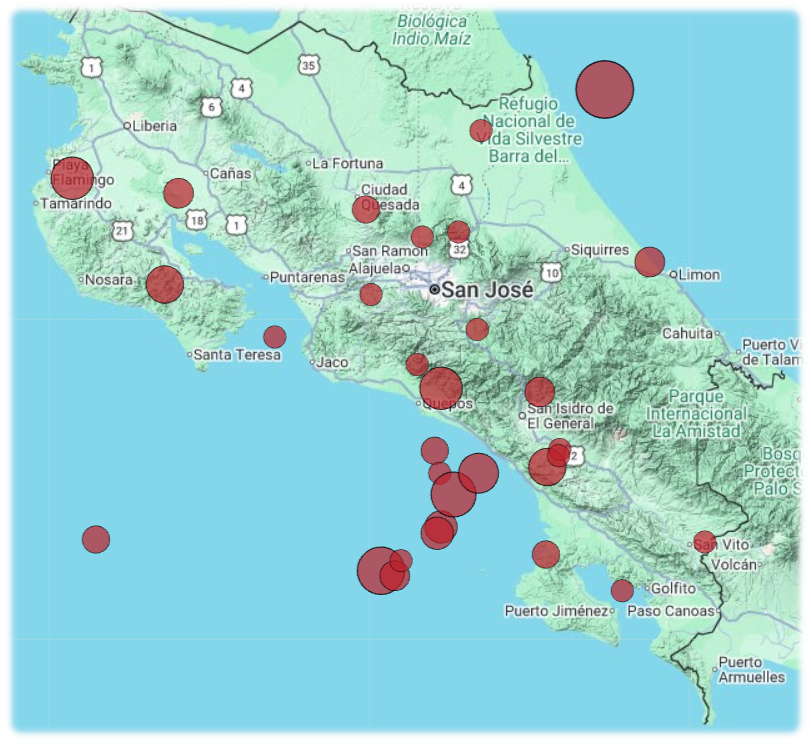
Below is a graph showing the total number of quakes in Costa Rica in the last 90 days as of February 9, 2026.

Below is a photo of a house that collapsed in the 2009 Cinchona earthquake, just north of the city of Alajuela in Costa Rica. The photo was taken from a helicopter by Capt. Diana Parzik of the U.S. Army.
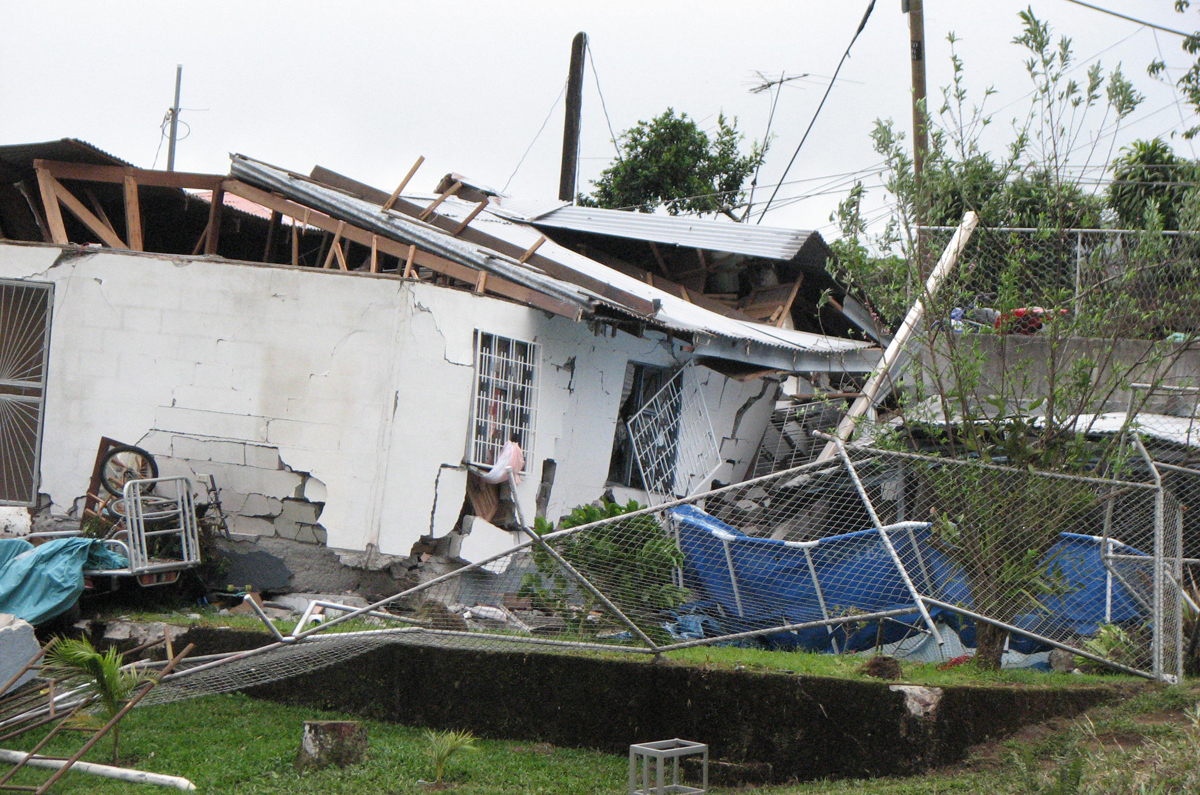
The 2009 Cinchona earthquake occurred at 1:21:35 pm local time on January 8 with an Mwc magnitude of 6.1 and a maximum Mercalli intensity of IX (Violent). The shock took place in northern Costa Rica, 30 kilometres (19 mi) north-northwest of San José and was felt throughout Costa Rica and in southern central Nicaragua.
Earthquake Statistics in Central America, South America, and The Caribbean
Central America is one of the world’s most seismically active and high-risk regions, situated on the Pacific Ring of Fire where several tectonic plates interact. The region experiences hundreds of earthquakes annually, primarily due to the Cocos Plate subducting beneath the Caribbean Plate.
General Statistics
Frequency: The wider Caribbean and Central American region experiences approximately 3,000 or more earthquakes of magnitude 1.5 or greater annually.
Major Events: Since 1970, at least 13 earthquakes of magnitude 7 or greater have occurred on or near the megathrust plate boundary.
Historical Data: A comprehensive catalog for the period of 1520-2020 includes over 260,000 earthquakes.
Country-Specific Activity
Earthquake activity varies by country based on proximity to major fault systems and the coverage of local seismic networks.
Highest Seismicity:
El Salvador and Costa Rica have the highest number of earthquakes in the historical catalog, accounting for approximately 58% of the total recorded events. This is largely due to robust seismic networks and high seismicity rates.
Nicaragua follows with about 18% of the total earthquakes.
Lower Seismicity:
Honduras has the fewest recorded earthquakes (less than 2%) in its territory, primarily because it is further from the subduction zone and has historically had a sparser seismic network compared to its neighbors.
Major Fault Systems
Significant seismic events (magnitude 6.0 or greater) are concentrated in several key areas:
Swan Fault (SF)
Polochic-Chixoy-Motagua fault system (PMFS) in Guatemala
El Salvador Fault Zone (ESFZ)
Nicaragua Depression (ND)
Central Costa Rica Deformed Belt (CCRDB)
Panama Fracture Zone (PFZ)
Recent Activity (as of January 2026)
In the past year, the largest earthquake in the general Caribbean and Central American region was a magnitude 7.6 near the Cayman Islands, while the largest on the Central American coast was a magnitude 5.9 near Quepos, Costa Rica.
The Caribbean experiences frequent seismic activity due to tectonic plate boundaries, with thousands of earthquakes recorded annually (over 3,000 in the Eastern Caribbean alone in a recent year), averaging around 1200 M3.8+ quakes yearly, including significant events like the 2021 Haiti quake (M7.2, ~2200 deaths) and large historic ones (e.g., 1907 Jamaica, 1946 DR) causing significant damage and tsunamis, highlighting high risk, with recent data showing hundreds of quakes daily and a general average of 15 M7+ quakes annually across the plate.
South America is highly seismically active due to the Nazca Plate subducting under the South American Plate, especially along the Pacific Ring of Fire, leading to frequent quakes, particularly in the Andes (Peru, Chile, Ecuador, Colombia, Venezuela). Statistics show thousands of quakes annually (mostly small), with significant events like the 1960 Chile M9.5 quake, and high risk for over 160 million people, though Chile has stronger building codes than northern countries like Bolivia or Venezuela. The Peru-Chile Trench and Andean Thrust Front are major fault zones, with activity concentrated west, but impacting continental crust.
Contact Us
Call or email us — we’ll be happy to assist you.
Panama +507 833-8110
Costa Rica +506 8333 4996
Canada 1 289 460 5101
USA 1 561 429 9001
Email: info@bb-icf.com